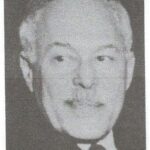
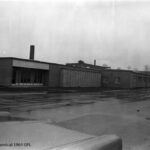
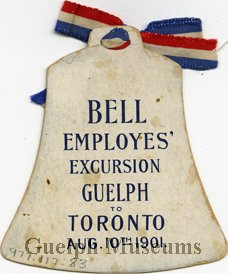
Guelph had become known for its piano and sewing machine companies, foundries, woollen mills and hardware manufacturers during the 19th and early 20th centuries. Its textiles and clothing companies also made their presence felt. However, Guelph also entered into the less commonly touted chemical industry beginning with E.C. McFarland. This small company, of which little is known, was located at 96 Quebec Street.
This was the only chemical company located in the downtown core. Fielding Chemical chose to establish its business somewhat outside – on Perth and Norwich, while Hart Chemicals moved into premises on Victoria Road.
The Fielding Chemical Company
In the early 1900s, the Fielding Chemical company arrived in Guelph. Recently incorporated, the company chose Guelph as its headquarters. The provisional directors were:
- William J Fielding
- Edward Fielding
- Norman Allan
- Duncan A. McPherson
- George C. Campbell
The company moved into the former premises of the Guelph Linseed Company which, in turn had once housed the Wellington (Inglis and Hunter) Foundry. The city provided Fielding Chemical with a grant of $1,000 to renovate the old factory for their purposes.
The stay, unfortunately, was of short duration. Although active in 1905 with 25 employees, it was in the hand of creditors in February 1907. Livingston of Baden was in charge of the liquidation process that saw, ironically, 25 creditors seeking redress.
Hart Chemicals (Products)

The History
Hart Chemicals was an American firm established in Jersey City, NJ, around 1940. In 1941, it established a branch plant in Guelph, moving into the old Dominion Linen plant on Victoria Road – right beside the river. The existence of a siding for the Guelph Junction Railway was seen as beneficial. It would facilitate receiving ingredients for and the shipping of its products.
As soon as it was settled, Hart Chemicals set about establishing a positive presence in the city. One way they accomplished this was through participating in community events. Its float, part of the Labour Day Parade in 1946, appeared on the front page of the Guelph Mercury on Tuesday, September 3.
 The President of the company, Emmanuel (Mannie) I. Birnbaum, furthered this image by becoming a prominent member of several groups, including
- Ontario Welfare Council – past president
- Children’s Aid Society of Guelph and Wellington County – past president
- Guelph Rotary Club – past president
- Guelph Recreation Commission – past chairman
- Guelph Welfare Council- past chairman
- Guelph Community Chest – director
- Guelph Chamber of Commerce – director
Products
The Guelph plant began to produce specialized products, with the main market originally being the textile industry. In January 1951, the Guelph Mercury wrote that the “Hart organization is one which is prominently identified with the progress of Guelph…Hart Products Company is known across Canada as being identified with the nation’s top-flight chemical engineering organization.” At that time, the “staff and management” consisted of:
- Emmanuel (Mannie) I. Birnbaum – President
- Harry Zimmerman – Chief Chemist at Hart Chemical (1967)
- John Helwig
- Cecil P. Braye
- Ronnall B. Burrows – IBM operator for Federal Wire (1967)
- John Gilbert
- James (Jim) Thring – An Engineer at Hart Chemical (1967)
- Lewis J. McKeon – still there in 1967
- Gordon E. Male – The Shipping Foreman for Hart Chemical Ltd (1967)
- John Bulge
- Sam Laughrin
- Louis P. Maschio – later a salesman for Williams-Hamilton Ltd. (1967)
- Roy Smith
- Barber
- Laughrin
- Ritchie
Hart Chemicals was a growing concern. Although starting small, by 1962, it had 120 employees. They expected to increase this by 60 people with the construction of a new hydrotrope plant that same year. The company also undertook a $3,000,000 expansion programme in June 1966. This was all under the guidance of the company’s president Mannie Birnbaum. He remained at the helm from the company’s inception until around 1968, when he became a consultant to the chemicals coordinator of Unilever.
Changes
In 1960, the Lever Brothers purchased Hart Chemicals. The name, however, remained the same. Money had already been spent on expanding the plant’s capabilities. These included one machine referred to as “The Monster.” To address this machinery’s requirements, the company also built an absorption tower. This handled the exhaust issues. Storage and waste disposal tanks were placed outside the building.
The result of these additions, and others made under the Lever Brothers, made Hart one of three companies in Canada producing ethylene oxide, a very dangerous and toxic chemical.
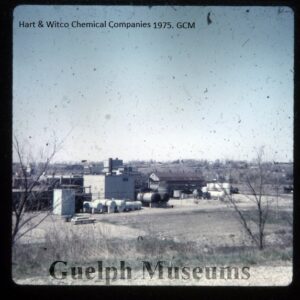 In the 1970s, the property was being shared with another chemical company – Witco Chemicals. Founded in America in 1920 as a chemical distributor, the company made its move into Canada in the 1960s. Little to nothing about the company’s sojourn in Guelph is currently available. In 1972 and 1975, it had registered the following chemicals for production in the Guelph plant:
- Barium Nonyl Phenate
- Cadmium 2-Ethylhexoate (Cadmium Octate)
The former is relatively benign. The latter is highly toxic. These chemicals were fewer than those Hart or Elmira’s Uniroyal were working with. However, Witco made a rather unsavoury name for itself with its association, along with DOW, for the production of Napalm.
A change in Hart Chemical’s ownership took place once again in 1992. Texaco Chemical purchased the company from National Starch and Chemical, owned by Unilever. At this point, Hart Chemical Company, Guelph, was manufacturing specialty surfactants. Their market included such industries as
- Detergent
- Energy
- Mining
- Personal care
- Textiles
The handling, production and shipping of chemicals and chemically based products, together with the location of Hart Chemicals, created a situation that could have been highly toxic to the community.
Spills
Chemical companies come with a risk. When situated by a river, the issues double. The spilling of chemicals into the river has been a problem with the companies that have occupied this building. While nothing is remarked about any material entering the water during the early years of Hart Chemicals, records do disclose such incidents occurring during the 1980s. The lack of data for the previous decades is probably not due to the company’s stringent guidelines but rather the result of the lack of intense scrutiny. This is at least valid for the 1940s, 1950s and 1960s. However, the company did put into place a protocol which included warning the nearby residences of what to do when such an event occurred. Pamphlets were sent out, and a few informative meetings were held for those living in the immediate area.
Several chemical spills did happen. The earliest noted took place in the 1980s. In 1982, propylene oxide made its way from the plant into the river. In 1983, it was propylene glycol that escaped the factory. This spill was ruled an accident (GM July 03, 1983). Former employees note that many chemicals were poured onto the land at the back of the plant. When the ground became saturated, it would have made its way into the river. There have also been allegations of the employees not taking proper precautions when handling chemicals.
Hart Chemicals no longer operates on this site. Huntsman Corporation (Huntsman PetroChemical Company of Houston, Texas) acquired the plant in 1986. It was managed by Ralph Shapiro and Rae Walton (operations manager) in 2001, who were involved in improving the reputation of the chemical industry in Guelph. In 2000, the company won an award from the Recycling Council of Ontario (RCO) for waste reduction. They showed further environmentally progressive tendencies when, in 2003, they reduced the potential risk to the environment by removing several chemical substances from their production. However, in 2005, Huntsman closed the Guelph plant. The Corporation felt the size of the Guelph facility made it no longer economically viable. PDI took over in 2006 and is currently (2026) operating there.
A List of Registered Chemicals Used by Hart in 1972 and 1975
Ammonium Lauryl Ether Sulphate.
Ammonium Stearate
Ammonium Toluene Sulphonate
Ammonium Xylene Sulphonate
Castor Oil, Sulphonated
Coconut Fatty Acid Diethanolamide
Copper Ethylenediaminetetraacetate
Dioctyl Sulphosuccinate
Fatty Acid, Ethoxylated
Fatty Alcohols, Ethoxylated
Fa’tty Amines, Ethoxylated
Iron Ethylenediaminetetraacetate
Lauric Diethanolamide
Manganese Ethylenediaminetetraacetate
Nonyl Phenol, Ethoxylated
Phenol Sulphonic Acid
Polyethylene Glycols
Potassium Toluene Sulphonate
Potassium Xylene Sulphonate
Sodium Lauryl Ether Sulphate
Sodium Toluene Sulphonate
Sodium Xylene Sulphonate
Tall Oil, Ethoxylated
Zinc Ethylenediaminetetraacetate 24.