

“As good as the rose is beautiful.” This was the slogan for the Rose Brand products made by Matthews-Wells in their plants. They opened the Guelph plant on Victoria Road in the former Dominion Linen factory in 1931. Initially, the company had only fifteen employees. They worked under the supervision of a surplus of owners/managers – four of them: James Matthews, Arthur Wells, Jim Dunlop and Howard S. Matthews.
Expansion of the plant began almost immediately, with two factory additions constructed. The first was in the spring of 1933; the second was in 1936. In January 1937, the company was once again expanding. However, this was more of a rearrangement and specific utilization of existing space in the 1936 extension.
With new machinery, the company was adding to its product line. They were expanding beyond pickles to manufacture jams, jellies, marmalade, and comparable products. These, as the Guelph Mercury stated, were “items allied to their present line.” Although the company had produced a “Zest” line of flavouring extracts in 1932, they were always known for the Rose brand of products.
By this time, the number of employees had grown to sixty. Employees were as local as the ingredients of the products. The number would fluctuate; however, the greatest number of employees was hired during the summer months.
This was a boon to many of Guelph’s young adults. The late newspaper man, Alan Ferris, worked there among the large pickling vats while others hulled strawberries or sorted the various fruits and vegetables intended for the jams, jellies and other products the company was producing. Some workers described pulling rats out of the vinegar vats out back or picking bugs from the berries intended to be made into jam.
The produce chosen for Matthews-Wells products came from all over Ontario. Different local and regional farms were major sources. Among them was Rosemount Orchards in Beamsville, Ontario.
Advertising Works
Matthews-Wells ran a 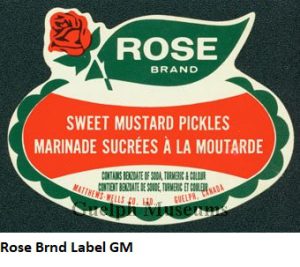 comprehensive advertising campaign to help sell its products. The ads appeared in several media forms. This included newspapers and radio.
Initially, it was in print. In 1937, the efforts paid off. The company won gold in the All-Canadian Group of the All-American Package Competition.
It was not simply the visuals, although the Rose Brand labels became highly visible and recognizable. In the 1950s, the company redesigned the jars and hired the J. Walter Thompson Company Ltd. Matthews-Wells combined the new approach with updated machinery by Phin Engineering and Consulting to ensure the labels would conform to the shape of the jars. This stepped up its advertising campaign to appeal to modern grocery stores and their shoppers. The company wanted its products to stand out on the shelves.
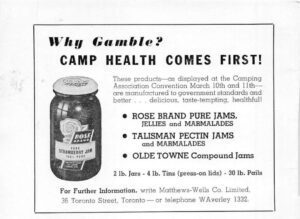 In 1950, they advertised in Camping Magazine, the article stated, “Why Gamble? Camp Health Comes First.” They then stressed the purity and great taste of their various jams and jellies. In 1951, the company advertised on the radio, sponsoring the “Showtime from Hollywood” show. A 1959 ad also extolled the products’ addictive qualities. It read “The Fridge Raider Strikes Again.” In short, it described how difficult it was to prevent family members from eating Rose Brand Pickles.
The company also launched the “Rose from a Rose Brand.” People would submit the name of a couple or an individual to the company. He/she or they would become eligible to win a bouquet of roses.
From its inception, the company also pushed its products at various conventions and exhibitions. The earliest was a major one. The British Industries Fair of March 1935 featured 51 Canadian companies. Five of these were from Guelph. They were:
- Matthews-Wells – Preserves, jams
- Guelph Elastic Hosiery – Flotation devices
- Northern Rubber – Rubber boots
- Sterling Rubber – Balloons and gloves
Later events relating specifically to the business included the 1958 annual Canners Show in Atlantic City, New Jersey.
During this time, the company continued to ensure its brand remained controlled. A challenge was made in 1949 against Rosario G. Dastous and Rose Canned Food Products. Matthews-Wells felt the use of a rose on the canned products was a patent infringement meant to deceive the grocery shopping public, even though the products in question differed and were referred to as “Rosie” and not Rose Brand.
Initially, Matthew-Wells won. However, they lost on appeal in the Supreme Court. The judge determined there was no infringement or theft of intellectual property, despite one of the most prominent patents and trademark agencies, Smart and Biggar, arguing on behalf of Matthews-Wells.
Nabisco Takes Over
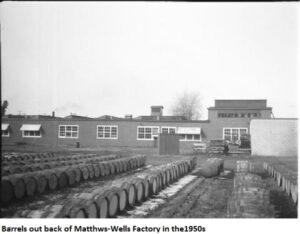 In 1959, Nabisco took over Matthews-Wells. The stated intent was to broaden its product line. Expansion of the existing facilities and installation of new equipment were also on the agenda, according to the 1959 annual report for the company. There were also several management changes. Mr. J. G. Matthews and Mr. H. S. Matthews, formerly President and Vice-President of the Matthews-Wells Company, announced that they were now retiring. Mr. J. S. Dunlop, another longtime employee and a vice-president, became the company’s President and General Manager. Mr. A. J. Colden remained Director of Sales, while Mr. J. M. Pollock was elected as a company Director (The Financial Post, October 28, 1959).
The company Nabisco was purchasing had grown substantially since its inception in the 1930s. By the early 1960s, the factory covered a 12-acre site, increasing the plant’s floor space to about 80,000 square feet. By 1962, the company employed about 160 people. Financially, the company appeared to be doing well. It sold nationally and 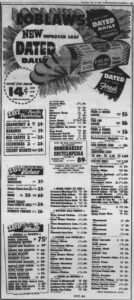 even internationally. Loblaws and Dominion grocery stores sold the Rose Brand product line.
Yet, despite Nabisco’s declaration, the union of what the Financial Post had declared “TWO GREAT COMPANIES JOIN[ING] HANDS,” the venture was not to be a lengthy one. The new owners ran the plant until 1968. During that year, they sold it to a Canadian firm – Robin Hood Flour. The reason given for the sale was simple. Nabisco Ltd. felt the market presence of the company was too small. It was also believed that any chances of growth within Nabisco were limited (National Biscuit Company (Nabisco) Annual Reports: 1969).
Robin Hood Flour
The change of ownership in 1968 was, on paper, not to impact the company. Initially, Robin Hood mentioned that it planned to put the sale of products under its own sales force (Victoria Daily Times, August 01, 1968). According to the news blurb in The Northwestern Miller, the Matthews-Wells line consisted of “10 varieties of Rose Brand jams and marmalades and approximately thirty types of pickles, relishes and olives. While the products continued to be manufactured in the Guelph plant, change was fast in coming. Rather than continue operating the plant, Robin Hood closed it in September 1968.
Addendum:
This is a list of many of the employees at Mathews-Wells in the included 1955 photo. Guido Sartor generously provided the names and photos. His mother is in the second row.

Back Row
2nd from Left Bill Turner Senior
9th From Left Herman Layton
10th from Left Bill Turner Jr.
5th from Right Jack Ralston ?
4th from Right Jack Meighan
5th Row
14th From Right Jim Borthwick
15th from Right Jack Dempsey
12th from Right Jimmy Bresson
Beside Jimmy Naish Saccary
9th from Right Jim Mugford
2nd from Right Len Richmond
4th Row
1st on Right Steve Lewis
3rd from Right Ozzie Harrington
4th from Right Clarance Spikman
14th from Right Bessie Borthwick
3rd Row
4th from Left Pat Guest
10th from Left Catherine Turner?
12th from Left Angelina Gazzola
2nd Row
8th from Right Elena Sartor (my mother)
6th from Left Muriel Cunningham (later Bedrosian)
8th from Left Marion Cunningham (later Mahoney)
12th from Right Joan Gidden
Front Row
9th from Right Shorty Carson (later Cunningham)


I grew up in that neighborhood, I recognize a lot of the names, my sister worked there for a short time.
Very interesting article. My grandfather was James Matthews…as a child growing up we never heard a thing about the company. The age of the internet has given much lost information as all of these people are gone now. Thank you very much. Regards. James Matthews.
My mom Marion Becker worked in the office.
Nice to know
That is my step father, Charles F. Bowyer, front row, very middle (the short man). Chuck started to work with Mathew Wells on the loading docks at a very young age and worked his way up to the purchasing department, 25 years total.
Thanks for letting me know. i tis always good to put a name to a face.