

Tires became a hot commodity as first bicycles and then automobiles became popular. In Guelph, several tire manufacturers entered the market, intent on making a profit. The only one that lasted for more than a couple of years was F.E. Partridge Rubber. It was the largest and most successful of Guelph’s tire-producing companies. First formed in Montreal, Quebec, in 1915 and incorporated in 1916, it made its move to Guelph in 1916.
Why Guelph?
The reason given in India Rubber World for this action was the need to expand both the size of its facilities and the types of products. The article stated that the “enlarged facilities being thus provided for the manufacture of the company’s numerous lines of rubber goods, as well as special advantages for handling an increasing trade in druggists’ sundries, automobile tubes and tire accessories.” The move to Guelph was soon to allow the company to focus on what became its best-known product -automobile tires.
The decision to relocate was not made by one person alone. In fact, it involved the company’s Board of Directors. However, the driving force behind it was the company’s President and founder, F. E. Partridge.
FE Partridge: The Man behind the Company
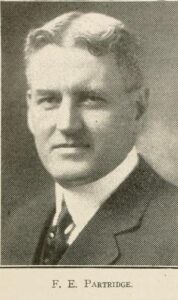 Frederick Everett Partridge was born in Bowdoinham, Maine, in 1873. He started to work in the rubber industry in 1894 at the age of 21. His first job was on the factory floor of the Maynard Rubber Co., a shoe factory in Claremont, New Hampshire. He worked his way up to superintendent before moving to the Boston Woven Hose and Rubber Co., Cambridge, Massachusetts, where he took over the position of night superintendent. After a 4-year stint in Boston, Partridge became general superintendent of the Combination Rubber Co. plant in Bloomfield, New Jersey.
From there, he was to change countries as well as jobs, becoming first superintendent and then manager of the Canadian Rubber Co., Montreal, Canada. Through hard work and dedication, he worked his way up to become vice-president of the company.
In 1915, FE Partridge appears to have decided he no longer wanted to work for other companies. He decided to establish his own business, going into partnership with Vincent Cooke. The result was the F.E. Partridge Rubber Company. Its products were commonplace to other existing rubber companies – various rubber articles, including druggist sundries, automotive inner tubes, and tire accessories.
On the Move
In late 1916, shortly after its incorporation, Partridge introduced the notion of leaving Montreal for Guelph. Supported by his Board of Directors, the company went ahead and leased the former facilities of Independent Rubber. It had been purchased by Guelph Tire & Rubber before renaming itself Standard Tire & Rubber.
Partridge Rubber took over the space and machinery in the factory at 40 Metcalfe (later Huron) Street. Partridge was to remain in control of this factory until it went into liquidation in 1927.
Although not a native of either Canada or Guelph, Partridge did become involved in various local social and industrial concerns. He shared with two other business owners the cost of sponsoring the Victoria Lawn Bowling club’s first tournament in 1919. Furthermore, he contributed to the industrial base of the city through the founding of another rubber-based manufacturer in Guelph. This one did not produce tires. Instead, it produced footwear. The company, a separate entity from Partridge Rubber, was Northern Rubber, located at the corner of Alice and Metcalfe.
Partridge also took part in national organizations beneficial to his company. He was a founding member of the influential Rubber Association of Canada. According to Footwear in Canada, he became one of its directors in 1920/21. He shared this position with two other notables in the rubber business:
1. WH Miner, Montreal – Miner Rubber Company
2. R. F. Foot Merritton Ontario – Independent Rubber Company
He became the association’s president in 1925.
The Growth of the Company
During the years the Partridge Rubber company operated in Guelph, it used mainly natural rubber and “gutta-percha.” The major sources were South America and Ceylon. Synthetic rubber was on the market, but was not as commonly employed in the making of tires and tire accessories until World War II forced manufacturers to turn to more reliable materials. The specific products coming out of the Guelph facility included:
- Tires
- Tubes
- Hot water bottles
- Tobacco pouches
- Rubber bathing caps
Partridge Rubber managed to set up and continue its production despite World War I, a conflict that the Industrial Banner said “upset manufacturing conditions.” In fact, the company actually expanded its physical facilities. By the end of that year, Partridge Rubber occupied what was described as “a modern five-storey structure.” Industrial Canada went on to say the daily output of the company was:
- 475 tires
- 600 tubes
- 500 hot water bottles
- 1,000 tobacco pouches
With a plan to further enlarge the premises in the coming year, Partridge Rubber was hoping to boost tire production to almost double its current output. This would mean hiring more men to work in the factory.
Innovations
However, the company did more than borrow from other companies. In 1917, the company showed its desire to innovate, creating a patent for a “non-skid” tire. They also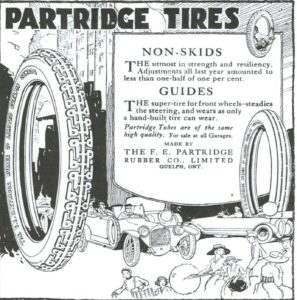 made certain to patent their trademarks beyond Canada and the United States. The Partridge trademark was registered as far as New Zealand. India Rubber World in 1920 described the Partridge Rubber Company, Ltd. trademark accordingly:
“Representation of a tire with a partridge standing within the lower part — pneumatic and solid tires, inner tubes, casings, tire accessories, mechanical rubber goods, druggists’ sundries, and all other goods manufactured from India rubber and gutta goods than no 40.”
Partridge also believed firmly in advertising his products. His campaigns were extensive, appearing in commercial and trade magazines as well as in newspapers. In 1925, he upped the ante by hiring a well-known publicist, Ralph W. Ashcroft. He was to handle advertising for both Partridge Rubber and Northern Rubber.
Yet, where the Partridge Rubber Company made a unique and long-term contribution was in retail. In 1919, the Daily Colonial printed that F.E. Partridge was planning to expand the sale of tires into retail stores. Interestingly enough, during this era, most tire sales were restricted to “garages and branches or service stations of the then big tire manufacturers.” Partridge was changing this by allowing local hardware stores, harness stores and other “general merchants” to sell automobile tires. The Retail Merchants’ Globe praised this approach stating:
“A new field holding out immense business possibilities to the retail trade almost in general, has been opened up by the P. E. Partridge Rubber Company, Limited. of Guelph, Ont. Hundreds of hardware dealers are already profiting by the opportunity afforded, while to the business of many a harness dealer the chance has meant a new lease of life.”
When questioned about the ability of a retailer to sell tires, Mr. F. E. Partridge is quoted as saying: “Tires, if they are good and are known, will sell themselves. The demand is everywhere.” This seems to be borne out by the increase in demand for Partridge Tires from at least one harness maker – Samuel Trees & Co., Ltd. In 1920, this company doubled their order for Partridge Tires. Through this innovation, Partridge was expanding the company’s sales, opening a new means of marketing to small and large tire firms and providing harness companies and similar factories another new chance to survive in a changing environment.
F. E. Partridge and Northern Rubber
In 1919, F.E. Partridge declared his intention to expand his company into another field. This was the production of rubber footwear. To achieve this, he pushed for certain concessions from the city in March of that year. According to Footwear in Canada, the company was hoping to “erect a rubber footwear factory … which [would] employ 500 people.” Among the hotly contested items were a tax exemption and $50,000 loan for 15 years.
The outcome was the construction of a commodious facility at the corner of Alice and Metcalfe streets. When completed, the reinforced concrete building, 80 x 200 feet, rose 4 storeys. The structure also had a basement.
The Industrial Banner noted the industry would be opening in 1920. When operational, it could produce 5,000 pairs of rubbers per day. The company also expected to hire around 500 hands to ensure this capacity would be met.
FE Partridge became the President of what would be known as Northern Rubber, although the name Partridge Rubber featured prominently in the first Northern rubber catalogue. He hired two other notable individuals in the rubber industry to assist him. These were:
1. F. W. Kramer, formerly superintendent of the Dominion Rubber Co. factory at St. Jerome, as vice-president and superintendent
2. A. F. Dwyer, formerly manager of the Maple Leaf Rubber Co., Port Dalhousie, as secretary-treasurer
At the time, Partridge viewed this factory as a means of expanding the company’s capabilities. He is quoted in the Guelph Mercury in 1919 saying that the footwear venture was part of his policy. It was a way for him to “compete with his competitors in all lines of the rubber business.” Although Northern Rubber was legally independent of the FE Partridge Rubber Company, its products – rubber footwear, were to bear the Partridge brand.
The Strike of April 1920
The company was not without its labour troubles. FE Partridge was, it appears, not sympathetic to unions. This is indicated by his reaction to the company’s only strike.
In April 1920, the workers went out. The 50-60 workers were asking for an increase in wages for piecework. All were members of the local Rubber Workers Union. The strike lasted into May with support from John A. Flett of the American Federation of Labour. He tried to work with management and workers to reach a solution, but Mr. Partridge refused to have a meeting.
This state of affairs continued. In May, the Labour Gazette recorded the strike remained “unterminated.” The same is noted for June. At this point, the number of active strikers had dwindled to the single digits. By July, the Gazette wrote: “Information received indicates conditions no longer affected.” This rather obtuse remark is the last one made about the FE Partridge Rubber Company strike of 1920.
Accidents
The 1920s were a period of growth. However, they also saw an increase in the accident rate of the company. From 1920 to 1923 inclusive, at least 4 accidents took place in the plant. Milling machinery claimed 3 fingers, one from J. Barrie in 1921 and 2 from A.L. Boles in 1923.
The most serious accident ever to take place in the plant occurred on May 19, 1922. It affected 4 workers. Two, T. Carto and J. H. Hogg were seriously scalded by the steam from a vulcanizing vat. Two other unnamed workers were “slightly scalded” but did not require hospitalization. At the time, they were being paid between $5 and $6 a day.
FE Partridge Closes
Despite safety concerns and a bitter strike, the company continued to produce rubber products. Ads for the company appeared in industrial magazines such as Hardware and Metal, Automotive News and The India Rubber World as well as such national magazines as Maclean’s and local publications as The O.A.C. Review. While growth and production seemed to have continued successfully over the earlier 1920s, it was not sustainable. The company did not last into the 1930s. It went into liquidation in February 1927,
Despite its flamboyant advertising and marketing campaigns, FE Partridge Rubber went into liquidation in 1927. It had divested itself of some of its plants in 1925. FE Partridge initially remained in Guelph but did not give up his involvement in the rubber industry.
Back to Montreal
In 1928, FE Partridge became the managing director of Perfection Rubber Company. He moved his family to Montreal. In 1931, he is listed as living at 6079 Terrebonne in the Notre-Dame de Grace Ward with his wife, Minerva, and his son, Richard. One of his daughters, Helen Suzanne Partridge, had stayed in Guelph. She had married Dr. Lionel Marshall Stuart. He is believed to have delivered many babies in the ward.
FE Partridge died in June 1939. Family lore says it was in a car accident. He is buried in Mount Royal Cemetery. His wife, Minerva Lavinia, joined him there in July, 1938.



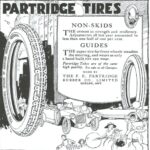


I’m thrilled to find this article. Thank for all the hard work in researching this info. FE Partridge was my great grandfather on my mothers side. I believed the family lived for a time on Queen St. FE Partridge remained in the tire business travelling as tire sales rep. Fun fact : The woman in the tire ad was my grandmother, Helen Suzanne Partridge. She was married to Dr Lionel Marshall Stuart who was a local doctor who delivered many babies in the ward. I also believe that he was instrumental in mobilizing the 11th Field Ambulance during WWII
Just some small bits of family lore.
Hi Christine,
I am related to Richard Partridge Sr, through his son James Henry Partridge. Then Cyrus Lodge Partridge is my Great Grandfather. Vivian Partridge is my Grandmother. If you have any information about the Partridges I look forward to hearing it. I’m on family search, or if you want to e-mail me please feel free too. Although it said I’m related to F E Partridge (Born 1873 in Maine) as 11th cousin, removed. That is a distant relation through the MacEwens. I feel we are much closer related than that. I just need help filling in the gaps on Family Search. Please feel free to e-mail me!!
Thank you!
– Evan
I am also thrilled to find this article, thank you! Frederick was my great grandfather as well, on my dad’s side. My grandfather, Richard Partridge, is our connection. Christine, I’d love to connect with you!
Hi Wenona,
I am also related to Richard Partridge Sr, through his son James Henry Partridge. Then Cyrus Lodge Partridge is my Great Grandfather. Vivian Partridge is my Grandmother. Please e-mail me if you have any information. I have learned about Partridge Tires, and after seeing your comment I feel we are closely related. I am trying to find out exactly where it links. Richard Partridge Sr. did have a son named Richard Partridge as well. I added photos to their profiles on familysearch. Please feel free to reach out to me with any information. Thank you!!
– Evan